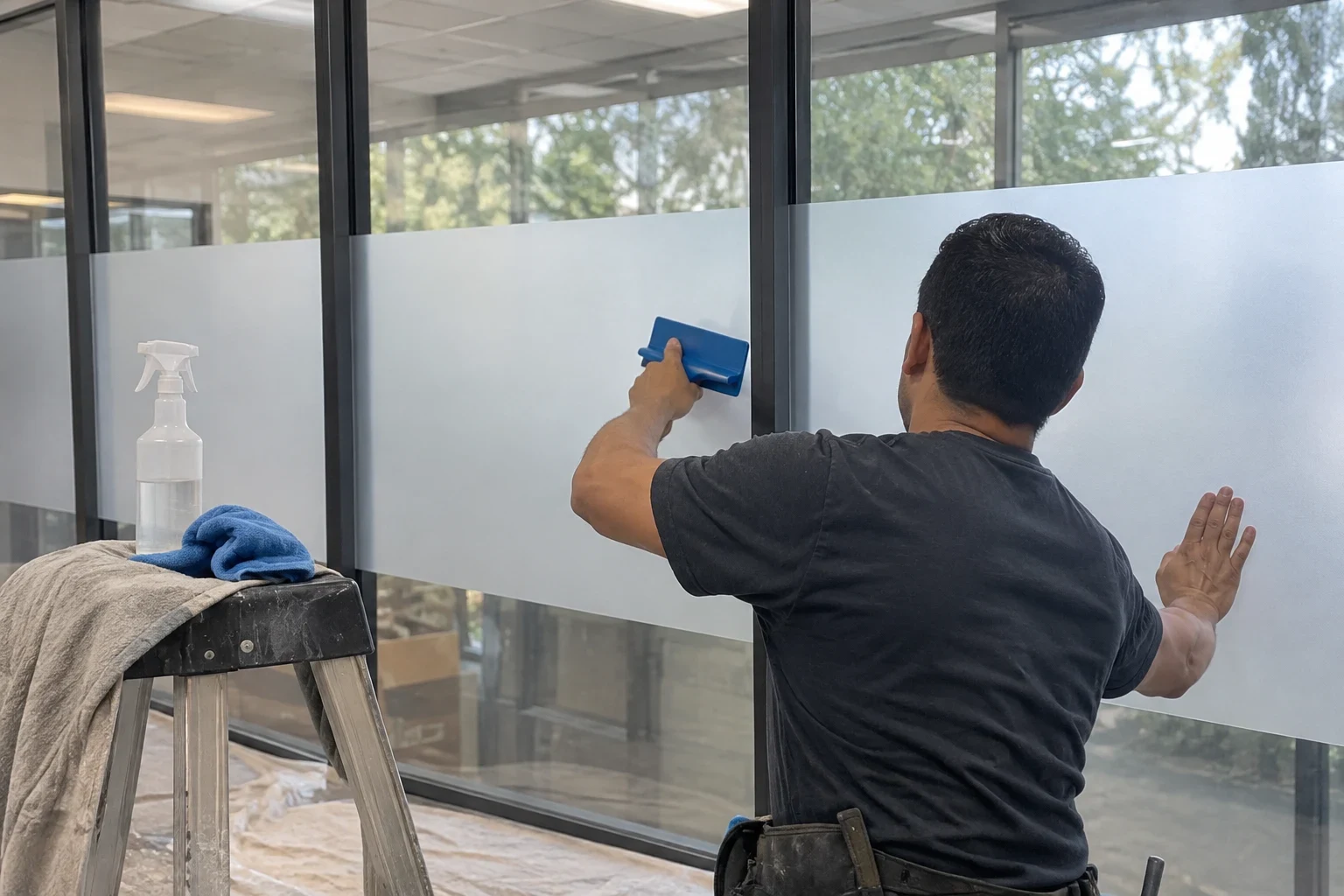
ServicesPrivacy Window Tinting
Privacy Window Tinting in Katy
Stop keeping the blinds shut all day. We install privacy window film that blocks the view into your rooms and still lets daylight through. We help you pick the right film for each window and explain where it works and where it doesn't.
Privacy Without Living in the Dark
Privacy window tinting is a film applied to the inside of your glass. Depending on the type, it either scatters light so no one can see shapes through it, or it reflects outside light so the glass looks like a mirror from the street. Either way, you keep the light and lose the fishbowl feeling.
The two main types behave very differently, and this is the part most people aren't told. Frosted and patterned films give privacy day and night. Mirrored films give strong privacy in daylight, but after dark, with your lights on inside, people outside can see in. We'll tell you which one fits each room before anything goes on the glass.
It's a good call for bathroom windows, front rooms that face the sidewalk, sidelights next to the front door, and offices or conference rooms that sit close to a parking lot or hallway.
What the Work Includes
A walk-through of every window
We look at each window you want covered, note which way it faces and ask how you use the room. A bathroom needs different film than a home office.
Film samples on your glass
We hold samples up to your actual windows so you can see the look from inside and outside. Frosted, mirrored, gradient and blackout options are all on the table.
Glass check before install
Some dual-pane and older glass can take stress from heat-absorbing films. We check the glass type and only recommend film that is a safe match for it.
Careful prep and clean install
We clean the glass, trim film to the edge of each pane and squeegee out water and air. Drop cloths go down under every window we work on.
Cleanup and care notes
We wipe down sills and frames and leave you simple instructions for the first few weeks while the film cures.
Signs Privacy Film Makes Sense
Blinds stay closed all day
If you keep shades down just so neighbors or people walking by can't see in, you're paying for windows you never get to enjoy.
A bathroom window faces the street
Frosted film solves this for good, day and night, and you can still open the window if it opens.
Glass beside the front door
Sidelights and transoms let anyone at the door see straight down the hall. Film blocks the view and keeps the entry bright.
Desks visible from outside
In offices, screens and paperwork near a window can be read from the sidewalk or parking lot. Privacy film keeps that inside.
Houses built close together
Many newer subdivisions put side windows a few feet from the neighbor's. Film lets you leave those windows uncovered.
How a Privacy Film Job Runs
- 1
Phone call and quick questions
You tell us which rooms feel exposed and about how many windows are involved. Then we pick a time to come out and look.
- 2
Free on-site quote
We measure, hold samples up to your glass and hand you a written, line-item quote. Nothing gets added later unless you agree to it.
- 3
Install day
Most homes take a few hours. We pull furniture back from the windows, cover the floors, then clean and film each pane one by one.
- 4
Curing and follow-up
For the first several days, sometimes a few weeks, the film can look slightly cloudy or have little pockets of moisture under it. Those go away on their own as the film dries out. Wait about a month before you clean the glass, then use a soft cloth and a cleaner without ammonia.
What Changes the Cost of Privacy Film
We price privacy film window by window, based on the film you pick. There is no flat package. Once we have seen your glass, you get the full number in writing. These are the things that push it up or down.
- How many panes, and how big
- More glass takes more film and more hours. A window split into many small panes takes longer than one large picture window with the same total area.
- The film you choose
- Plain frosted film is the lower-cost option. Patterns, gradients and blackout cost more. Mirrored films that also block heat are at the top end.
- Hard-to-reach glass
- A tall window over a stairwell, a transom on the second floor or a pane tucked behind shelving means ladders, scaffolding or more time setting up before we can start.
- Old film that has to go
- Film that is already peeling or bubbling must be stripped and the adhesive cleaned off before new film can stick. That step adds labor to the job.
Privacy Window Tinting Questions
Something not covered here? (281) 824-1833
Does privacy film still work after dark when my lights are on?
Frosted and blackout films do. They block the view both day and night. Mirrored film is different. Once the room is brighter than the outdoors, people outside can see in. For a room you use at night, pair mirrored film with blinds or pick frosted instead.
Will privacy film make my rooms dark?
Frosted film lets most daylight through, just softened. Mirrored film cuts more light but rooms still feel open. Only blackout film makes a room dark, and we'd only suggest it where you want that, like a media room or a nursery.
Does my HOA allow mirrored film?
Many HOAs in the Katy area have rules about how windows look from the street, and mirrored film can fall under them. Frosted film usually looks like plain textured glass from outside. Check with your HOA first, and we can give you film specs to show them.
A storm broke a filmed window. Will insurance cover the film?
It depends on your policy and your adjuster. We can photograph the broken glass and damaged film and write a line-item estimate for replacing the film. You include that with your claim. The adjuster makes the coverage call, not us.
Can I take the film off later?
Yes. Privacy film comes off without hurting the glass. We can remove it for you and clean off the leftover adhesive so the window looks the way it did before.
Get Your Windows Back
Tell us which rooms feel too exposed. We'll come out, show you film on your own glass and give you a written quote with no pressure to sign.